
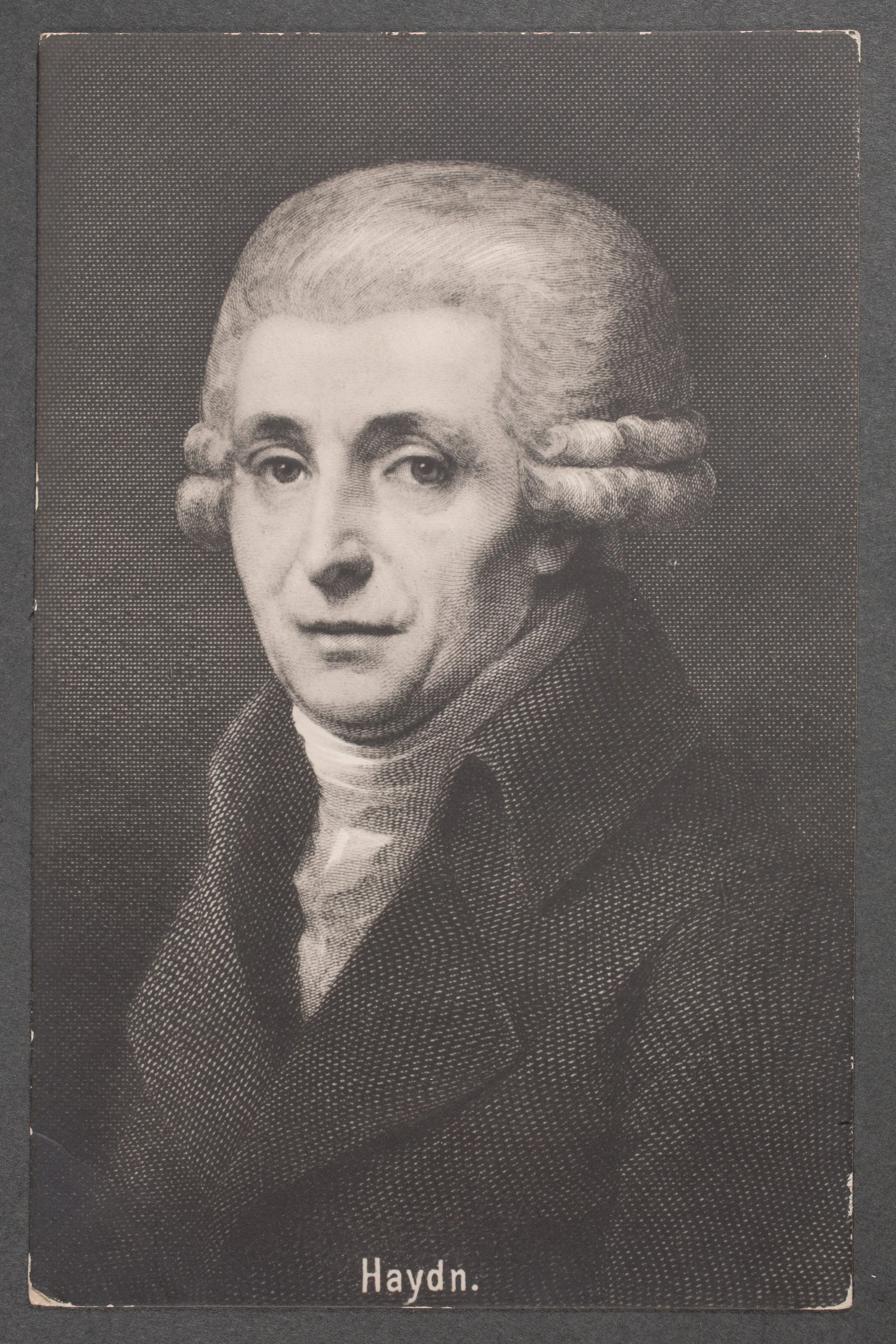
<a href="https://commons.wikimedia.org/wiki/File:Joseph_Haydn_1732-1809,_%C3%B6sterrikisk_komposit%C3%B6r_-_SLSA_1270_34_foto_857.jpg">Society of Swedish Literature in Finland</a>, <a href="https://creativecommons.org/licenses/by/4.0">CC BY 4.0</a>, via Wikimedia Commons
Scherzo (Sonata in F major Hob. XV1/9, Third movement: Scherzo) Haydn Grade 2
This piece was in the Grade 2 ABRSM syllabus in 1999 – 2000. The player must project a level of bravado and aplomb when playing this piece.
Character/story of the piece – this piece will appeal to wide range of players due to its effervescent and energetic character. It has a dance-like quality with its near constant use of semiquaver patterns which provide the music with a feeling of momentum and vigour. Considering that each hand takes on the role of a dancer, the R.H. will need to take prominence. However, the L.H. has an important role to play, as it provides energy and depth for the music.
Form – this piece is in ternary from with the second section modulating to C major by the end. Each section contains two phrases with each being four bars in length.
Main part of the music – this should occur at the end of the piece, as the music has a relentless feeling moving to the end part. The player needs to be careful with the level of dynamics used as the piece was written in the Classical Period. Each section will require a focal point too.
Phrasing – as already mentioned, each section contains tow phrases with each being four bars in length. Each set of two phrases are presented as sets of two, with the second phrase ‘answering’ the first phrase. All of the phrases commence with an upbeat; the player must consider how this affects the character of the music.
Tempo, time signature and rhythm patterns – there are varying suggestions as to what an appropriate tempo is for this piece ranging from 80 to 104. 92 crotchet beats per minute is a suitable tempo as the piece requires a reasonably fast tempo to convey the character of the music. The writing of the music in duple time is entirely suitable, as it helps to provide the music with energy and vitality. The player will need to ensure that the semiquaver patterns are played with evenness. There is a danger that the player may play the quavers, in bar 4 for example, too fast in comparison with the semiquaver patterns. Some players may not hold the crotchets for long enough in bar 1, for example or conversely not lift their L.H. for the rest.
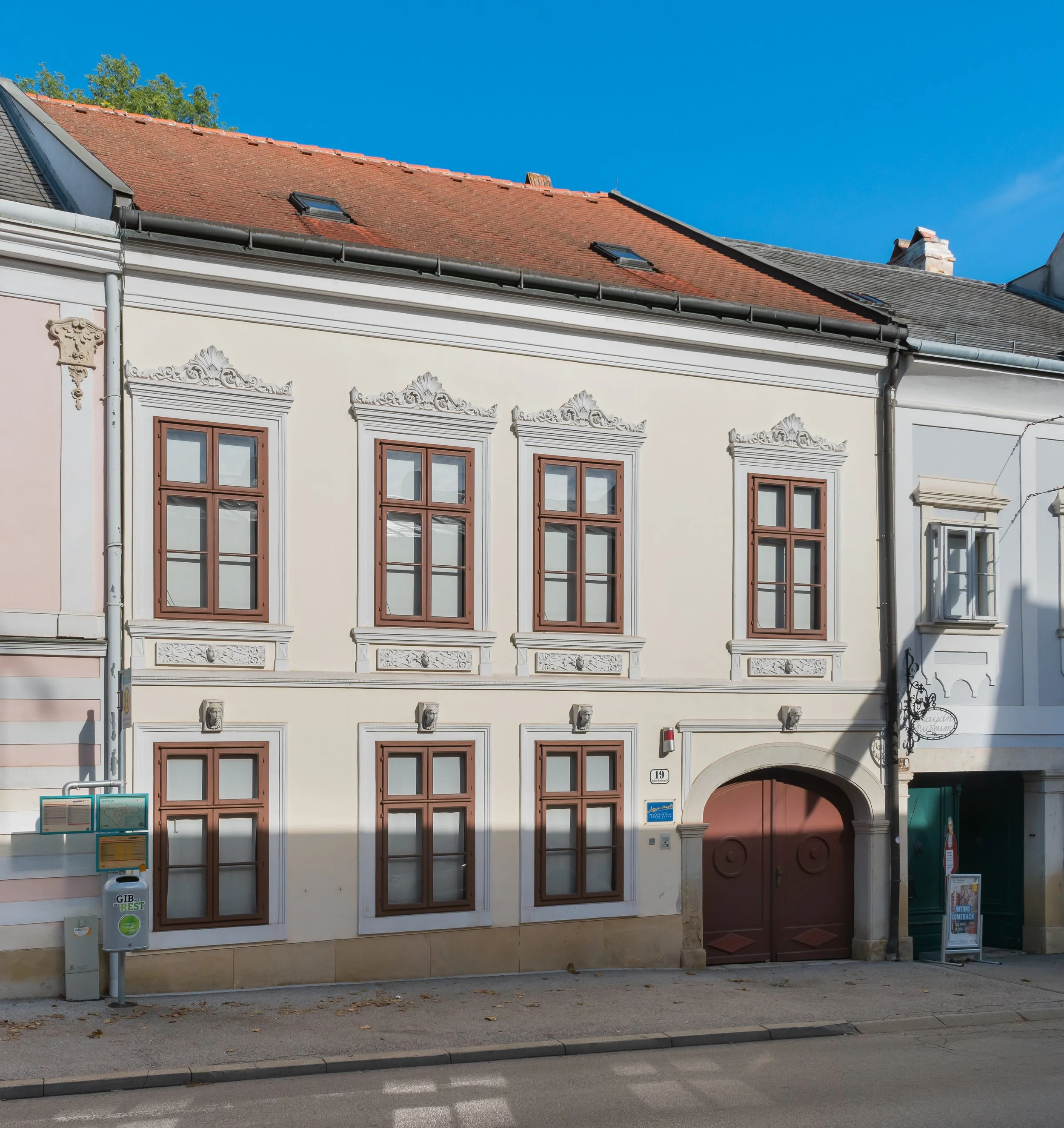

Building at Joseph-Haydn-Gasse 19 in Eisenstadt, Burgenland, Austria
"https://commons.wikimedia.org/wiki/File:Joseph-Haydn-Gasse_19_in_Eisenstadt_(2).jpg">Krzysztof Golik</a>, <a href="https://creativecommons.org/licenses/by-sa/4.0">CC BY-SA 4.0</a>, via Wikimedia Commons

Articulation/Touch – all the semiquaver patterns need to be played with a legato touch whereas the quavers and crotchets should be played with a detached touch. In bar 4, the last R.H. quaver should be separated from the previous quaver chord. This will ensure that the quaver upbeat is preserved. Other lifts, such as in bar 9 between the last R.H. B and the subsequent D contribute an elegance and breath to the music. This should be applied in the same situations elsewhere in the music. The touch required in the R.H. needs to be intense with a slight brightness which is achieved with firm fingertips, energy into the keys, a fast descent accompanied by a relaxed wrist and supportive arm. A similar touch is necessary in the L.H. too with the fingers remaining close to the keys. A degree of resonance will be required when the crotchets are played.
Dynamics – as has already been alluded to, the dynamic levels must be carefully calibrated as dynamics that are too loud will be inappropriate for the Musical Period. The dynamics should have an overall cumulative effect with the first section being played at a mp to mf level, a contrast in the second section with quieter dynamics overall and the final section being played at a mf to f level. A change in the L.H.’s dynamics will make considerable difference to the overall dynamics. Variety of the L.H.’s dynamics is important especially considering it has a repetitious quality for most of the piece. The semiquaver patterns in the L.H. in the second section require careful playing with the player needing to take particular care of the sound that the thumb plays.
Balance between the hands – the balance is to the R.H in this piece. This will be a little difficult for some players to achieve considering the registers that the hands are using. The L.H. is in a very robust area of the piano and could easily drown out the R.H.
Agogic effects – this is not a major consideration in this piece; a little slowing at the ends of the second and third sections will add a lively touch to the playing.
Considerations
· Bring out the lower notes of the L.H. chords.
· The L.H. patterns in the second section contain an Alberti bass style.
· Bring out the upper notes in the R.H. chords.
· Notice the two-note slur in bars 4 and 20.
· There is a danger that the semiquaver patterns are played too slowly in comparison with the overall beat. Constant use of the metronome is mandatory using different speeds.
· Most practise should be at a slower speed so that the player can ensure that evenness, accuracy and co-ordination is maintained.
· This piece is an opportunity to showcase how important the learning and playing of similar motion scales, arpeggios and broken chords are.
· Ensure that the semiquaver patterns are played with precision and clarity.